DFF funds 16 new legal actions for digital rights – 2026 mid-year update on new grants
DFF funds 16 new legal actions for digital rights – 2026 mid-year update on new grants

By Thomas Vink, 18th August 2026
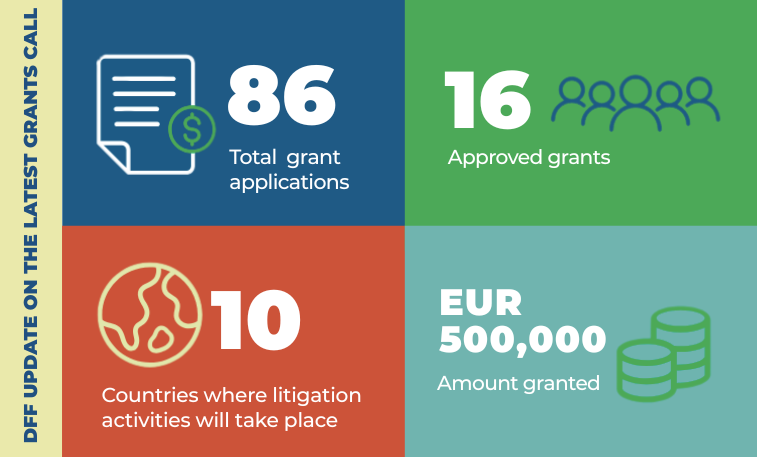
In June, we approved 16 new grants worth EUR 500,000 supporting legal action and research to advance digital rights in Europe. Scroll down to see the full list of new grantee partners.
A major milestone is that we have now funded over 100 different organisations and individuals. This comes through 164 grants worth EUR 5.5 million since 2018.
The 86 applications we received was another record, beating the record of 73 applications from our previous application round. This is around triple the amount of applications we typically received per round up until 2024.
Applications were reviewed and grants were decided by the Community Peer Group. Since 2025, this external group representing the wider community has been deciding which projects DFF should fund, rather than DFF making the decisions.
An ongoing trend of many new organisations and individuals applying each time continued and even increased, indicating that a) more new groups are finding out about DFF and/or b) that the work we have done to expand and strengthen the digital rights ecosystem through our hubs and other collaboration results in new grant applicants.
51 of the 86 applications were from first-time applicants, and 68 applications were from organisations yet to receive a grant from DFF. Of the organisations and one individual to receive grants this round, 13 received funds from DFF for the first time.
Analysis of first-time applicants and grantees
| Year | First-time applicants | Applicants to receive funding on the first try | First-time grantees |
|---|---|---|---|
| 2026 mid-year | 51 | 11 (22%) | 13 (out of 17 total grantees) |
| 2025 | 68 | 11 (16%) | 15 (out of 22) |
| 2024 | 38 | 9 (24%) | 14 (out of 23) |
| 2023 | 40 | 10 (25%) | 16 (out of 21) |
| 2022 | 11 | N/A | 10 (out of 17) |
| 2021 | 35 | N/A | 12 (out of 16) |
The 86 applications from this round were spread across 29 different countries. Armenia, Estonia, Moldova and Slovenia are countries represented where we have not yet funded anyone. The Netherlands (9), Turkey (8) and the UK (8) had the largest number of applications, followed by Greece (6), Spain (6), France (5) and Italy (4). Albania, Armenia, Bulgaria, North Macedonia, Poland, Ukraine, and the US all had three applications.
The 16 latest grants support activities across 10 countries including Georgia, France, Italy, Netherlands, North Macedonia, Norway, Poland, Slovakia, Slovenia, Spain and the UK, alongside one multi-country project and one case at the European Court of Human Rights. Additionally, some of the cases are being taken with communities from countries outside Europe, including Myanmar and Sudan.
The largest grant amount this round was EUR 65,000 and the smallest grant amount was EUR 8,500.
New DFF Grants
Seven new grants support legal action on the following topics:
- Institute for Human Rights Skopje: Unlawful data use by police in North Macedonia for profiling and discrimination.
- Liberty: UK government forcing Apple to break encryption.
- Public Interest Law Centre: Surveillance towers used to prosecute migrants and deny asylum in the UK.
- (RE)Claim: Illegal and discriminatory data processing by police in France against racialised young people.
- A coalition challenging negative socio-ecological impacts from rapid data centre expansion.
- An individual challenging the use of facial recognition technology against participants in public assemblies with a case at the European Court of Human Rights.
- A coalition challenging human rights abuses by using data shared by a telecommunications company.
Nine new grants support research activities on the following topics:
- Asociación Española Contra las Terapias de Conversión: Online promotion and sale of “conversion therapy” materials Spain.
- European Fem Institute: Meta’s failure to stop gender-based cyberviolence in Poland.
- Fundación Ciudadana Civio: Hidden automated decisions for social services in Spain.
- Lex Collective: Online hate speech and incitement linked to the Sudan Conflict (case filed in France in partnership with Sudanese individuals and groups).
- Platform for International Cooperation on Undocumented Migrants (PICUM): Digitalisation and data sharing of public administration used for migration enforcement (Regional).
- Center for Civil and Human Rights – Poradňa: Discrimination against Roma due to digitalisation of public transport ticketing in Slovakia.
- Public Interest Litigation Project (PILP) and Leitmotiv: Hyperscale data centre development in the Netherlands.
- Rete Lenford: Claiming the right to health for Trans People in Italy through data protection.
- Roma Feminist Collective: Police surveillance and discrimination against Romani communities.
These organisations support a wide range of communities whose rights will be advanced through their projects, including Roma, racialised communities, refugees and migrants, LGBTI, women, and human rights defenders. For the first time we are funding projects related to environmental justice, with two applications using legal action to challenge data centres (in Spain and the Netherlands).
Not all information can be publicised at this stage. As more of the projects are made public and progress we will share more information about the groups involved and outcomes of the litigation through our case study page.
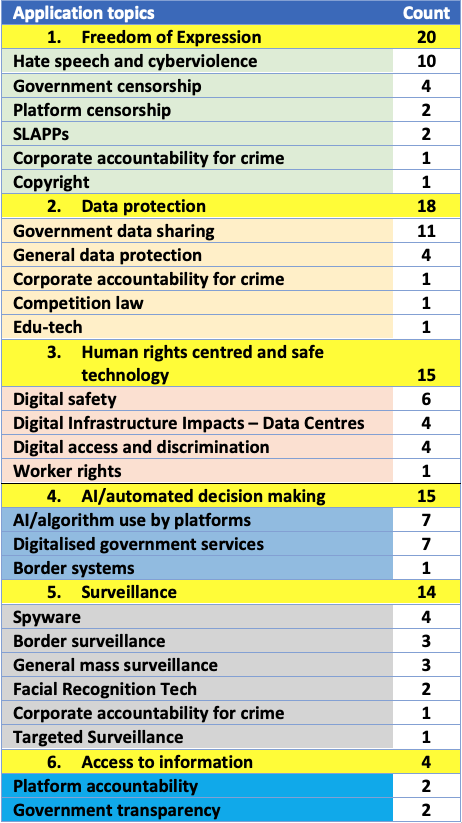
Finally, we also continue to see a vast range of different topics and issues covered in the applications we receive. Topic areas that stood out in the last round included hate speech and cyberviolence, government data sharing, algorithm and AI use by platforms and digitalised government services.
Looking Ahead
We expect to open our next call for applications in December 2026.
Remember to check out the resources on our website, including our application guides and litigation toolkit, to start thinking about or preparing a future application.
If you want to see more detail about the outcomes of the projects of our grantee partners, make sure to browse through our case study page and read Highlighting Litigation Success in the Digital Rights Community, a report we published in 2025 that summarises and analyses the impact achieved through strategic litigation we have supported between 2018 and 2024.