Our events
DFF regularly organises events and convenings as well as develops resources to support organisations and individuals in pursuing litigation on digital rights issues. This area of work includes projects which have their own vision and objectives, while also sharing common goals and adhering to transversal values based on decolonial and anti-oppressive principles.
Past events
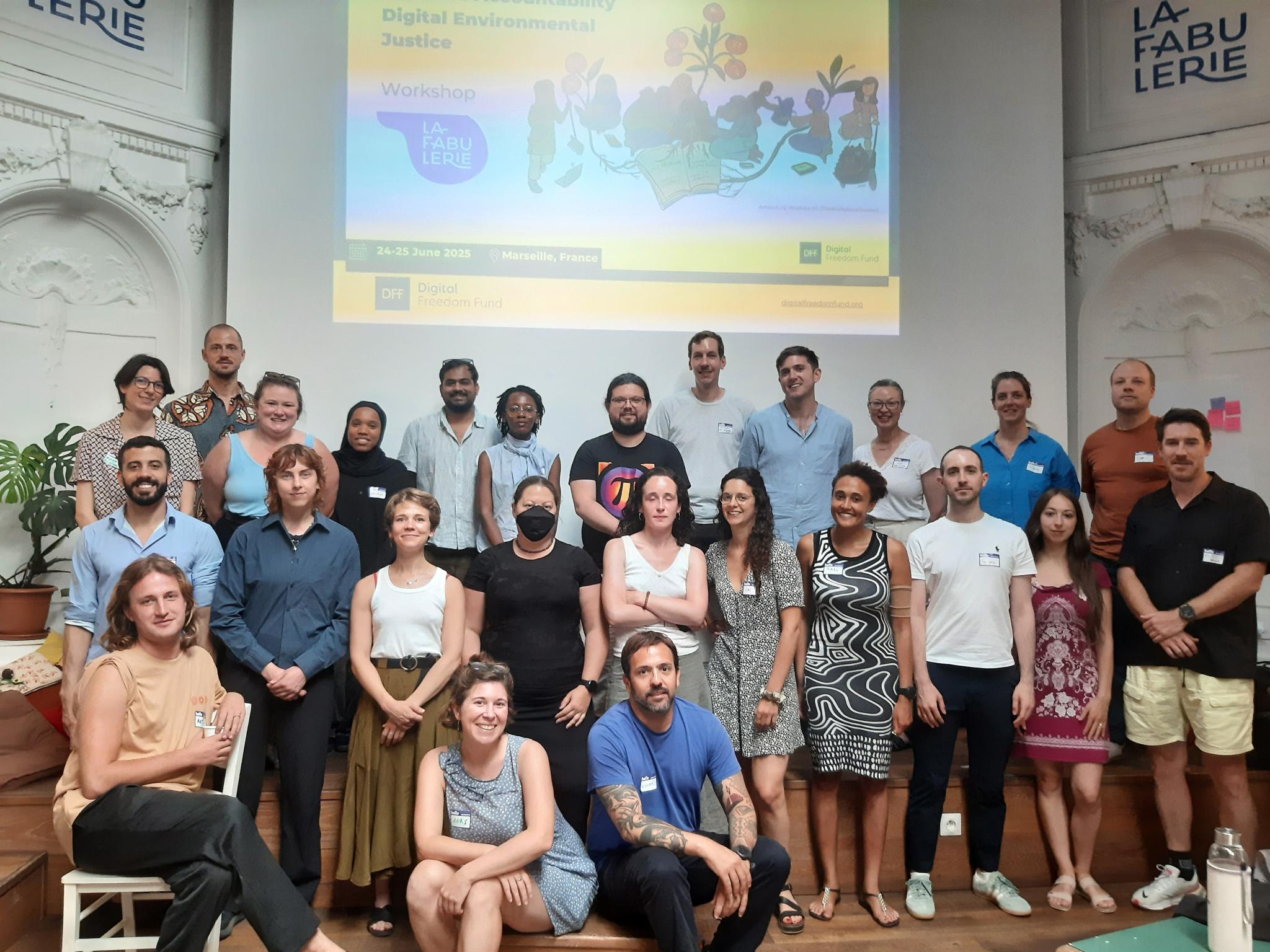
This in-person workshop aimed to bring together different organisations working on digital environmental justice and platform accountability issues to collectively brainstorm and start collaborating more on possible litigation and quasi-judicial avenues for holding big tech platforms and other corporations accountable for human rights violations and environmental degradation at the intersection of digital rights and environmental justice. The workshop was a part of our Community Programme and was fully funded by Luminate Strategic Initiatives.
This event was part of our Community Strengthening and Support (CSS) programmatic work. The two-day workshop aimed to provide a space for the digital rights community to further reflect on the collective dimension of digital rights and situate collective redress within broader collective action efforts aiming to counter tech-driven fundamental rights violations, particularly those disproportionately affecting marginalised communities.
We extend our gratitude to Luminate Strategic Initiatives for their generous support in making this event possible.
During this exclusive three-day consultation and feedback workshop, litigators and collective redress experts from diverse jurisdictions delved into strategic discussions on using collective redress mechanisms to advance digital and Charter rights litigation.
This workshop was a crucial component of the digiRISE project, and we offered it as an invite-only platform for collaborative engagement.
The first DFF digital rights virtual drop-in law clinic ran from March to April 2024. The clinic hosted sixteen sessions during which successful applicants interacted with digital rights strategic litigation experts from across Europe.
The objectives of this drop-in clinic were to provide beneficiary organisations with detailed and case-specific information on digital rights and to enable them to identify when and to what extent Charter rights apply in the digital sphere and how they can be relied upon in strategic litigation.
In Berlin, our 2024 strategy meeting brought together diverse groups to discuss digital rights, set future grant priorities for DFF, and exchange skills and knowledge.
We covered many topics, among them, Algorithm and Labour Rights, Prisoners’ Internet Access, Pegasus Spyware, and a Dutch ruling against ethnic profiling. Further sessions explored Queer & Trans* Rights, Surveillance, Accessing Welfare, AI and Disability, and EU Charter Rights, highlighting the strong interconnectedness of social justice issues with digital rights. We also shared knowledge sessions on Movement Lawyering, Leadership, Decolonial approaches to digital archival work, and data-driven policing, among many others. Stay tuned for more information on key takeaways.
The panelists deliberated on digital rights during times of conflict, the dichotomy between European and global concerns, and the preservation of digital rights within the context of war crimes.
Discourse centred around the egregious acts in the Democratic Republic of Congo and the proliferation of technological militarisation by nations such as Israel and China. Panelists delved into the historical backdrop of war crimes, the protocols outlined in the Geneva Conventions, and the formation of the International Criminal Court (ICC). Additionally, attention was drawn to the surge of far-right ideologies in Europe, as well as the ongoing crises in Sudan, Haiti, Tigray, Ukraine, and Palestine.
With the EU Representative Actions Directive recently entering into force, we believe that collective action will become a crucial legal avenue to harness collective power before national courts to unlock meaningful digital rights protection and enforcement.
During the just concluded Speaker Series, we discussed collective redress mechanisms and cases from the EU and around the world. It was co-organised with the digiRISE project, and overlapped with our fourth DFF Speaker Series, titled Digital Rights are Charter Rights.
We mapped out the issues at the intersection of technology, online platforms, and social and racial justice, to identify potential partnership opportunities and to start strategising toward building transformative action- and movement- oriented coalitions, in order to support the expansion of an intersectional transfeminist and antiracist space working on these issues.
Speaker Series 2023 - Digital Rights are Charter Rights
During this session led by Dr. Nawal Mustafa, Legal officer at Public Interest Litigation Project (PILP) and Jill Toh, PhD student at Institute for Information Law (IViR) and co-founder of the Racism and Technology Center we discussed how digital technologies are developed using race as a factor to systematically discriminate and oppress individuals and/or populations.
This was the second follow- up workshop aimed at sharing best practices for enforcing the Charter in digital rights litigation. We unpacked different legal avenues in using the Charter in digital rights litigation, we shared successes and lessons learnt from utilising the EU Charter in strategic litigation, and we will ensure that the digital rights community are equipped with the tools to utilise the EU Charter in digital rights strategic litigation.
The decolonising data event session takes a critical look at how data infrastructures centralise power while dispossessing and disenfranchising certain groups and communities. The session also explores strategies that can be adopted by activists and organisations to push and fight for the decolonisation of data and broader infrastructures.
Our annual strategic litigation retreat took place on the 11-14 September 2023. This retreat specifically focused on platform accountability and collective redress. Participants worked on litigation and advocacy plans for a strategic case of their choice by means of group work, individual brainstorming and knowledge and skills sharing.
During DFF’s Access to Justice in Data Protection workshop held in Dublin in December 2022, we hosted collaborative discussions on access to justice in the #DataProtection space using different tools in the #GDPR, as well as other legal frameworks & strategies.
The Digital Freedom Fund brought litigators, campaigners, and technologists together to identify the opportunities and risks in litigation from both a legal and technological perspective. #platformaccountability #strategiclitigation
Our Annual Strategy Meeting, is where we bring together a wide group of organisations and individuals working on digital rights topics to jointly strategise, share information and lessons, and co-ordinate work going forward. It helps us define our grant-making funding priorities and overall strategy going forward. Our 2023 strategy meeting was held on March 14-16, 2023, in Berlin, Germany.
DFF’s third Speaker Series delved into the power of an anti-colonial lens when examining harmful tech and the states and companies who deploy it. Discover how it exacerbates racist policing, exploits workers, and devastates our environment. Watch the series for firsthand accounts from inspiring movements fighting back and building a better, more just world.
Participants in the decolonising the digital rights field process share what they worked on in the partnership and funding working groups.
The final session in the ‘Another Tech is Possible?’ speaker series saw Ife Thompson, Laurence Meyer and Sarah Chander in conversation to explore how we can build effective movements against digital policing.
In October 2020, DFF held a three-day workshop that aimed to tackle the use of AI in the time of COVID-19. It brought together participants at the forefront of challenging government use of automated decision-making systems (ADMs), who brainstormed strategies for safeguarding digital rights compromised by these systems during the pandemic. We have published a report, as well as numerous other resources, from the workshop here.
In October 2018, DFF held a workshop that took a long-term view on “Future-proofing our Digital Rights”. Participants from across Europe looked ahead at the opportunities, threats and challenges our future selves could encounter when faced with violations of our digital rights. The event allowed us to strategise, plan and get out in front of these trends.
The workshop was accompanied by an essay series that looks at the digital rights implications of algorithmic decision making, connected children’s toys, the Internet of Things, the “splinternet”, and “digital divides”.
In May 2019, DFF funded a workshop that explored the practical elements to take into account when litigating under the General Data Protection Regulation (GDPR). The meeting was organised by Access Now and noyb. This was followed, in September 2019, by a workshop on “Unlocking the Strategic Litigation Opportunities of the GDPR”, where 21 participants from across Europe mapped ongoing efforts in GDPR enforcement. The aim was to identify those areas where the need for the enforcement of data protection rights is greatest and to develop strategies around that across a variety of contexts.
In June 2019, DFF organised a transatlantic meeting in Amsterdam that brought together academics, law clinics and practitioners to explore how the digital rights field can better connect with academia.
Participants also considered how to engage and inspire students in digital rights litigation, and how to promote international collaboration among digital rights scholars, teachers, advocates and activists.